On-chain
Agency vs. direct KOL booking: what's the markup actually buying you?
Agencies typically add a 15% to 25% markup on top of creator rates, plus a separate retainer of $3,000 to $25,000+ a month. One documented example found a 12-creator quarterly program cost $26,600 booked direct versus $61,352 through a mid-tier agency, a $34,752 difference for the same creators.
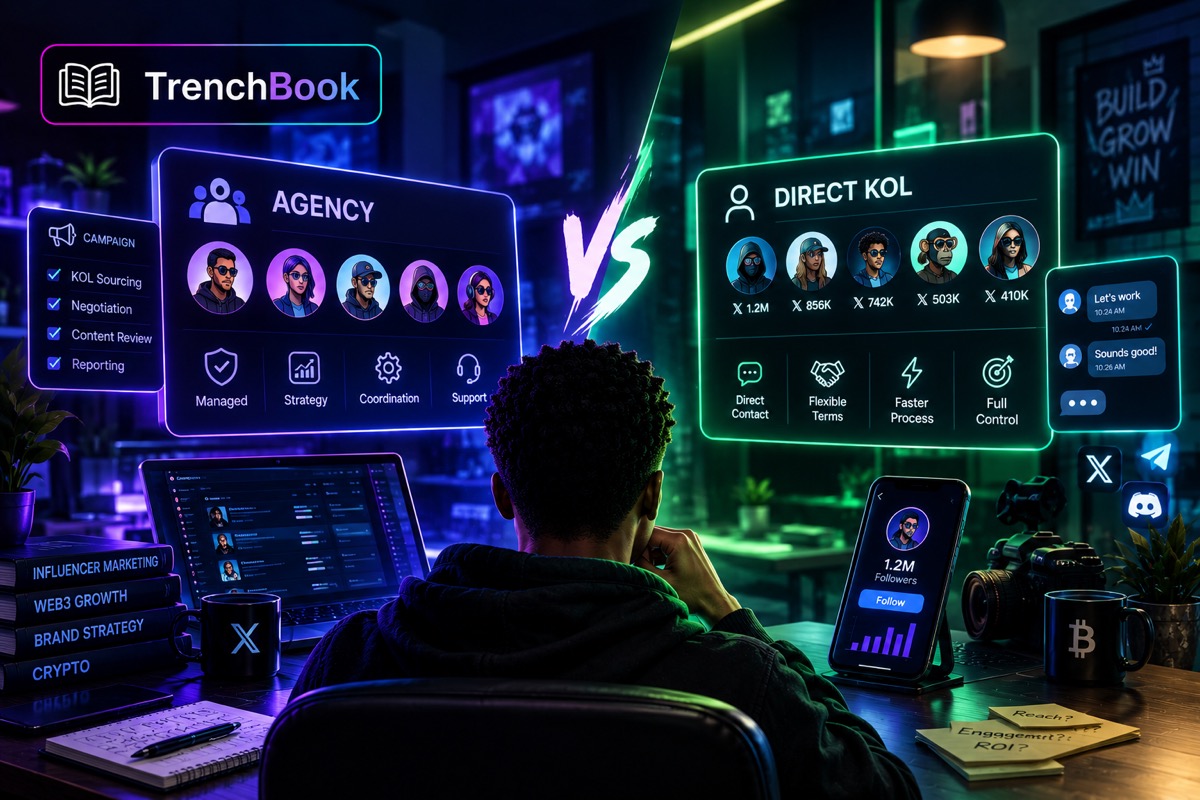
What’s the actual difference between agency and direct booking?
Direct booking means a project pays a KOL’s rate straight to the KOL, handling outreach, negotiation, and follow-up itself, including how payment actually moves through escrow.
An agency sits between the two, sourcing and vetting creators, negotiating terms, and billing the project a combined rate that includes the creator’s fee plus the agency’s own cut.
The difference isn’t just who sends the invoice. It’s who absorbs the sourcing time and who carries the markup.
How much markup does an agency add?
More than most projects expect until they see it itemized.
Influencer Advisory’s cost breakdown puts the typical markup on creator rates at 15% to 25%, with negotiation room down to 18% to 20% on multi-quarter contracts.
Separately, InfluencerFee’s pricing guide confirms the same range, noting a creator who normally charges $5,000 can be invoiced to the brand at $6,000 to $6,250, with the agency retaining the difference. On top of that markup sits a monthly retainer, running $3,000 to $8,000 for boutique shops and $15,000 to $25,000 or more for full-service agencies.
What does the markup actually pay for?
Sourcing, vetting, negotiation, and reporting, in theory, though the value of that work depends entirely on how much of it a project would otherwise do itself.
The cost difference is concrete: Influencer Advisory’s worked example for a 12-creator quarterly program at $1,800 per creator came to $26,600 booked direct versus $61,352 through a mid-tier agency, a gap of $34,752 for the identical creator lineup.
The gap buys sourcing time and negotiation leverage, but it only pays for itself if a project genuinely lacks the bandwidth to do that work in-house.
When does an agency’s cost make sense?
Once deal volume crosses a specific threshold, the math flips.
Influencer Advisory’s guidance recommends an agency once a program runs 12 or more creator deals per quarter, since below that line, direct booking through workflow tools costing $300 to $800 a month is more cost-effective.
InfluencerFee’s guide draws a similar line at $20,000 to $50,000 in monthly managed spend, below which “agency fees generally not justified.”
The table below lines up the two models against that threshold.
| Model | Cost for 12 creators (example) | Extra fees | Best fit |
|---|---|---|---|
| Direct booking | $26,600 | Workflow tools, $300 to $800/month | Under 12 deals/quarter |
| Boutique agency | Higher, plus retainer | 15% to 25% markup + $3K to $8K/month | Small to mid programs |
| Mid-tier agency | $61,352 | 15% to 25% markup + $8K to $15K/month | 12+ deals/quarter |
| Enterprise agency | Higher still | 15% to 25% markup + $15K to $25K+/month | $50,000+/month managed spend |
Does going direct increase the risk of getting ghosted?
Not for the reason most people assume.
Ainfluencer’s research on ghosting found that a 20% ghost rate or higher signals a process problem rather than a booking-channel problem, and one case study saw ghost rate rise from 34% to 41% after tightening vetting, then drop to 11% after redesigning how the brand communicated with creators.
Ghosting is driven by relationship design, not by whether an intermediary is involved. An agency’s process discipline can reduce ghosting, but a project running its own tight process direct can match that result without paying the markup.
So which one should you use?
Match the model to deal volume rather than defaulting to whichever one sounds more professional.
Under roughly 12 deals a quarter, direct booking with a disciplined process saves the 15% to 25% markup and the retainer.
Above that volume, an agency’s sourcing capacity starts to earn its cost back in time saved.
A vetted marketplace sits between the two, offering pre-checked creators and escrow protection without the retainer, and projects that want that middle path can book a five-KOL wave instead of choosing between a full agency and cold outreach.
Oliver Cade is Head of Growth at Trenchbook, where he runs KOL wave campaigns for token launches. Find him on X at @oliver_lad.
Questions
What does an influencer marketing agency charge on top of creator fees?
Agencies commonly apply a 15% to 25% markup on the creator's own rate, plus a separate monthly retainer ranging from roughly $3,000 for boutique shops to $25,000 or more for full-service agencies, depending on program size.
Is it cheaper to book influencers directly?
Usually, at smaller volumes. One documented comparison found a 12-creator quarterly program cost $26,600 booked direct versus $61,352 through a mid-tier agency, a difference of roughly $34,752 for the exact same creator lineup.
When should you use an agency instead of booking direct?
Agency economics tend to work out once a program runs 12 or more creator deals per quarter, or once managed influencer spend clears roughly $20,000 to $50,000 a month, since sourcing and vetting at that volume becomes a full-time job either way.
Do influencers ghost more often when booked directly?
Not because of direct booking itself. Ghosting rates are driven mainly by process design rather than whether a brand goes direct or through an agency, with one case study cutting ghost rate from 34% to 11% by redesigning the relationship experience rather than switching booking channels.
What does an agency retainer actually cover?
A retainer typically pays for strategy, creator sourcing, negotiation, and reporting, and explicitly excludes the creator payments themselves, which are billed separately, often with the markup already built into the invoiced rate.
If you already have the contract address and want a slot today, the seven-field form is at /book. It takes about a minute, and the desk replies before you have finished reading this page.
Related notes