Retail
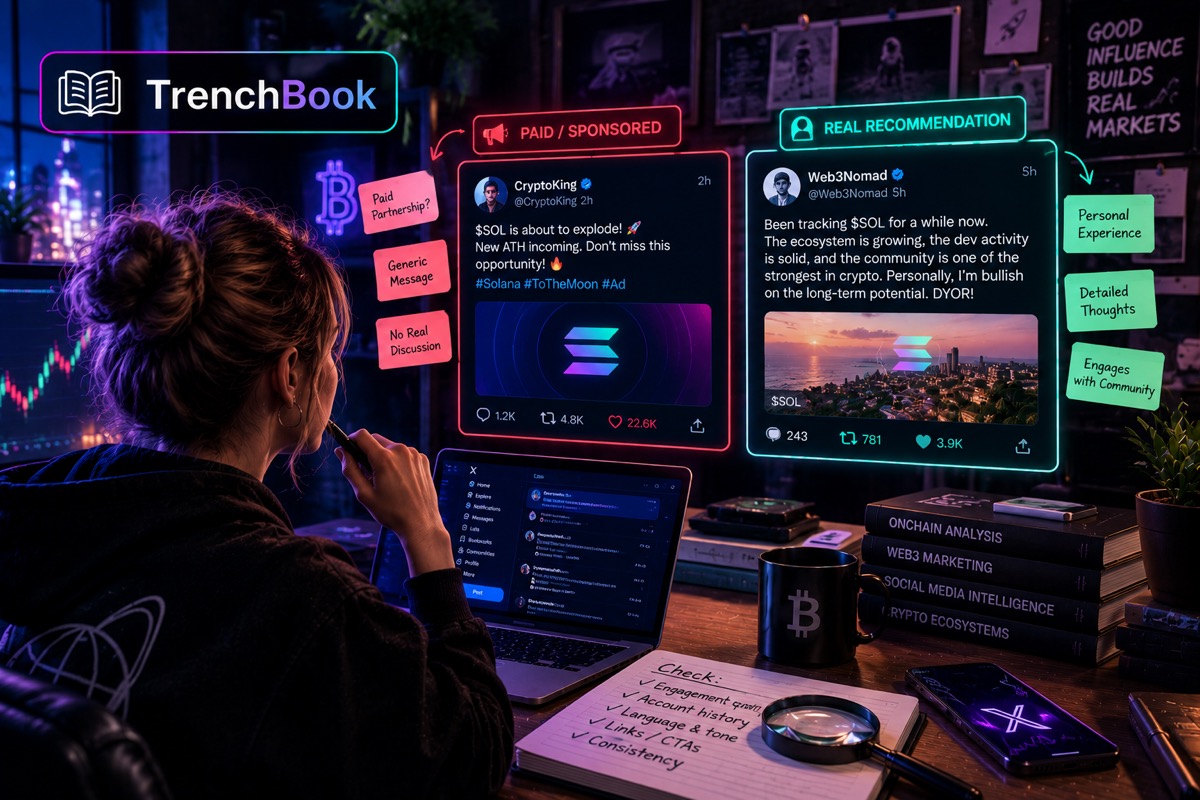
How to spot a paid crypto tweet vs a real recommendation
A paid crypto tweet is legally required to disclose the relationship under FTC and SEC rules, but many don't. The SEC fined Kim Kardashian $1.26 million in 2022 for touting EthereumMax without disclosing payment, and researchers flag coordinated multi-account promotion and guaranteed-return language as the clearest tells of an undisclosed ad.
Last updated: September 3, 2026
What’s the legal difference between a paid post and a real recommendation?
A real recommendation is a creator’s own view, offered without payment or a token allocation tied to it.
A paid post exists because someone compensated the creator, whether in cash, tokens, or a fee, and that arrangement is what the law requires them to disclose.
The distinction isn’t about whether the take is good or bad. It’s about whether the audience knows an incentive shaped it before they read it.
What does a proper disclosure actually look like?
According to FTC endorsement guidance compiled by The Social Media Law Firm, acceptable disclosures use plain language: “Ad,” “Sponsored,” “Paid partnership with [Brand],” or “Gifted by [Brand],” placed prominently rather than buried.
The guidance is explicit that “a disclosure is not effective if audiences have to hunt for it.” Vague terms like “collab,” “partner,” or “#sp” are flagged as commonly failing that standard, since they don’t clearly tell a reader money changed hands.
What are the clearest signs a tweet is paid promotion?
Several patterns show up consistently across documented crypto shilling cases.
Cointelegraph’s breakdown of shilling red flags lists overhyped promises like “100x potential” or “guaranteed returns,” anonymous or unverifiable teams, sudden coordinated promotion from multiple influencers at once, an absence of any working product, and artificial urgency such as “presale ends in 2 hours.”
Any one of these alone isn’t proof of a paid, undisclosed post, but two or more appearing together is a strong signal.
Why did the SEC fine Kim Kardashian over a crypto tweet?
Because she promoted the token EthereumMax to her audience without disclosing that she was paid to do it.
The SEC’s press release on the case confirms she agreed to pay $1.26 million to settle charges of unlawfully touting a crypto asset security without disclosure.
The case matters beyond the size of the fine: it established that a single undisclosed post from a large account can draw direct regulatory action, not just public criticism.
How do you check if a KOL discloses paid posts consistently?
Look at a creator’s last 15 to 20 posts promoting any project and check whether disclosure language appears in the same place every time, not just occasionally.
A KOL who discloses inconsistently, clearly labeling some posts and leaving others ambiguous, is a bigger risk than one who always uses vague language, since the inconsistency suggests the disclosed posts were the ones with contractual requirements attached.
The table below compares what each side of the line typically looks like.
| Signal | Paid, undisclosed promotion | Disclosed ad or genuine recommendation |
|---|---|---|
| Language | “Guaranteed,” “100x,” “can’t lose” | Hedged, specific, includes downside risk |
| Team visibility | Anonymous or unverifiable | Named, checkable history |
| Timing | Sudden, coordinated with other accounts | Independent, doesn’t cluster with other posts |
| Disclosure | Missing or buried at the end | “Ad” or “Sponsored” placed up front |
| Urgency | Countdown, limited spots, deadline pressure | No artificial time pressure |
So how do you tell the difference in practice?
Read the post for disclosure language first, then check whether the account’s other recent posts follow the same pattern.
If the disclosure is missing and two or more of the red flags above are present, treat the post as promotion regardless of how it’s framed.
A verification pass on engagement authenticity and the honest track record covered in are crypto KOL calls trustworthy both apply here: the disclosure tells you the incentive, but it’s still on you to check the substance underneath it.
Oliver Cade is Head of Growth at Trenchbook, where he covers KOL vetting and market structure. Find him on X at @oliver_lad.
NFA: This article is for informational purposes only and is not financial advice. Disclosure practices and enforcement standards can change; verify current rules independently before acting on any promotional post.
Questions
Are crypto influencers legally required to disclose paid promotions?
Yes. Under FTC endorsement guidelines, any material connection between a creator and a project, including payment or free tokens, must be disclosed clearly and placed where the audience can't miss it, and touting a security without disclosure can also trigger SEC action.
What counts as a proper disclosure on a crypto tweet?
Plain language like "Ad," "Sponsored," or "Paid partnership with [project]" placed in the first lines of the post, not buried at the end or hidden behind a vague term like "collab" or "#sp."
What happened with Kim Kardashian and EthereumMax?
The SEC charged Kim Kardashian with unlawfully touting EthereumMax tokens to her Instagram followers without disclosing a payment for the post, and she settled the charges for $1.26 million in 2022.
What are the biggest red flags of a paid promotion pretending to be organic?
Guaranteed-return language, an anonymous or unverifiable team, sudden coordinated posts from multiple unrelated accounts at once, no working product, and artificial urgency around a deadline are the most common signs.
Does a disclosed paid post mean the recommendation is worthless?
Not necessarily. A disclosed paid post at least tells you the incentive structure up front, which is more honest than an undisclosed one; the disclosure doesn't make the token good or bad, but it tells you how to weigh the recommendation.
The booking details for this shape are at /read-kol-calls.
Related notes