On-chain
Single tweet vs KOL wave: which one for a launch?
A single KOL tweet reaches one audience once and fades within hours; a coordinated KOL wave publishes across dozens of creators in a tight window to signal attention and lets the market feel something is cooking. icoda.io's Banana Gun case study used 69 KOLs across 77 posts in 72 hours and saw price rise 176% in that span, a scale single tweets can't replicate.
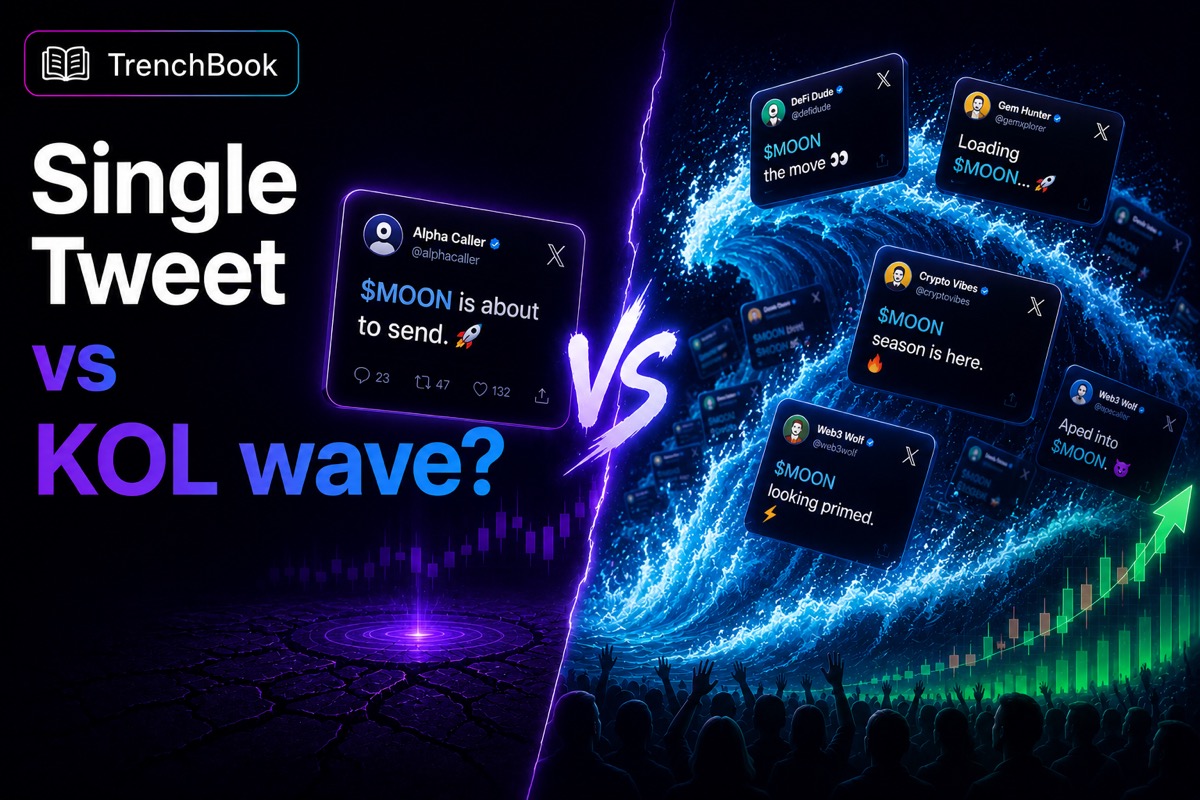
What’s the actual difference between a single tweet and a KOL wave?
A single tweet is one creator publishing once, on their own timeline, at an agreed time or whatever time suits them. A KOL wave is a coordinated group of creators publishing within a defined window, often 24 to 72 hours, so the posts land close enough together to look like independent confirmation rather than one paid call. The mechanics are different, not just the scale. A wave is planned around a launch moment; a single tweet is usually planned around a budget.
When does a single tweet make sense?
A single tweet fits early-stage testing, when a project wants to check whether a message or a creator’s audience converts before committing a larger budget. It also fits niche announcements aimed at one specific community where broad reach would be wasted spend. Disence’s budget guide, referenced in Trenchbook’s KOL pricing breakdown, puts a typical test-phase spend at $5,000 to $15,000 across three to five micro-KOLs, which is closer to a handful of single tweets than a full wave. A single tweet is also the right call when a project simply cannot afford a coordinated roster yet.
When does a KOL wave make sense?
A wave fits moments that need to look like a market event rather than a marketing post: a token generation event, a graduation to a DEX, or a major protocol announcement. The goal isn’t just reach, it’s concentrating attention into a window short enough that the timing itself becomes part of the signal. A Coinmonks framework on Medium describes staggering a seven-day amplification sequence, moving from a founder announcement through mega-tier, mid-tier, and micro-tier creators, specifically because “most campaigns disappear within hours because they lack coordinated promotion.”
How much does each option cost, and how do they compare?
The two options differ across more than just price, and the gap widens once you account for how many creators and how much coordination each one requires.
| Dimension | Single tweet | KOL wave |
|---|---|---|
| Typical cost | $100 to $50,000+ per post, by tier | $25,000 to $100,000+ for a coordinated roster |
| Number of creators | 1 | 5 to 70+ |
| Publish window | One moment, creator’s choice | 24 to 72 hours, sometimes runs for weeks |
| Visibility half-life | Hours | Days, reinforced by repetition |
| Best fit | Testing, niche audience, tight budget | Launches, graduations, major announcements |
What does the data actually say about coordinated waves?
The clearest public example is icoda.io’s Banana Gun campaign case study, which activated 69 unique influencers for 77 total publications, 43 on YouTube and 34 on X, reaching a combined 4.27 million tier-1 Twitter followers within a 72-hour window. The token’s price moved from $15.63 to $43.12 in that window, a 176% increase, and its market cap reached $112.3 million within six weeks. Smaller waves show a similar pattern at lower scale.
A vetting framework from FORKOFF found a 12-KOL seeding round generated 41 posts and 2.1 million combined views, with accounts in the 50,000-to-200,000 follower range driving roughly 5x the ROI of accounts above 500,000 followers.
How do you decide which one fits your launch?
Match the format to what the moment needs, not to whatever budget happens to be available that week. If the goal is validating a message or a creator relationship before scaling up, a single tweet or a handful of them is the lower-risk starting point. If the goal is a launch, a graduation, or any moment where the appearance of broad, simultaneous interest matters, a wave is the format built for that job, and projects that want one pre-assembled can book a five-KOL wave instead of coordinating dozens of individual creators by hand.
The seven-field booking form is at /book.
Oliver Cade is Head of Growth at Trenchbook, where he runs KOL wave campaigns for token launches. Find him on X at @oliver_lad.
Questions
Is it better to use one KOL or multiple KOLs for a launch?
For a launch moment specifically, multiple KOLs publishing in a coordinated window tend to outperform a single post, since the near-simultaneous coverage reads as independent confirmation rather than one paid call. A single KOL is better suited to testing a message before committing a larger budget.
How many KOLs should a token launch use?
Case studies range widely by budget: smaller seeding rounds run around 10 to 12 KOLs, while larger coordinated campaigns like icoda.io's Banana Gun case study used 69 KOLs across 77 posts. The right number depends on budget and how large a launch moment needs to look.
Does a KOL wave cost more than a single tweet?
Yes, substantially. A single tweet can run from $100 to $50,000 or more depending on the creator's tier, while a coordinated wave with a full roster typically costs $25,000 to $100,000 or more, since it involves paying and coordinating many creators at once.
How long should a KOL wave run?
Most waves run 24 to 72 hours to keep the posts close enough together to read as a single moment, though some staggered campaigns extend coverage across a 7-day sequence moving from top-tier announcements down to micro-tier follow-up posts.
What is a KOL wave in crypto marketing?
A KOL wave is a coordinated group of creators publishing about the same project within a tight, pre-agreed window, timed to a specific launch moment so the combined coverage reads as broad market interest rather than a single sponsored post.
If you already have the contract address and want a slot today, the seven-field form is at /book. It takes about a minute, and the desk replies before you have finished reading this page.
Related notes